
How Fat Actually Destroys Your Cells — What Science Says
We tend to think of fat as something that just sits under our skin. A number on the scale. A problem we can see in the mirror.
But science tells a very different story. Excess fat — especially certain types — literally destroys cells from the inside. And it happens at the molecular level long before you see any visible symptoms.
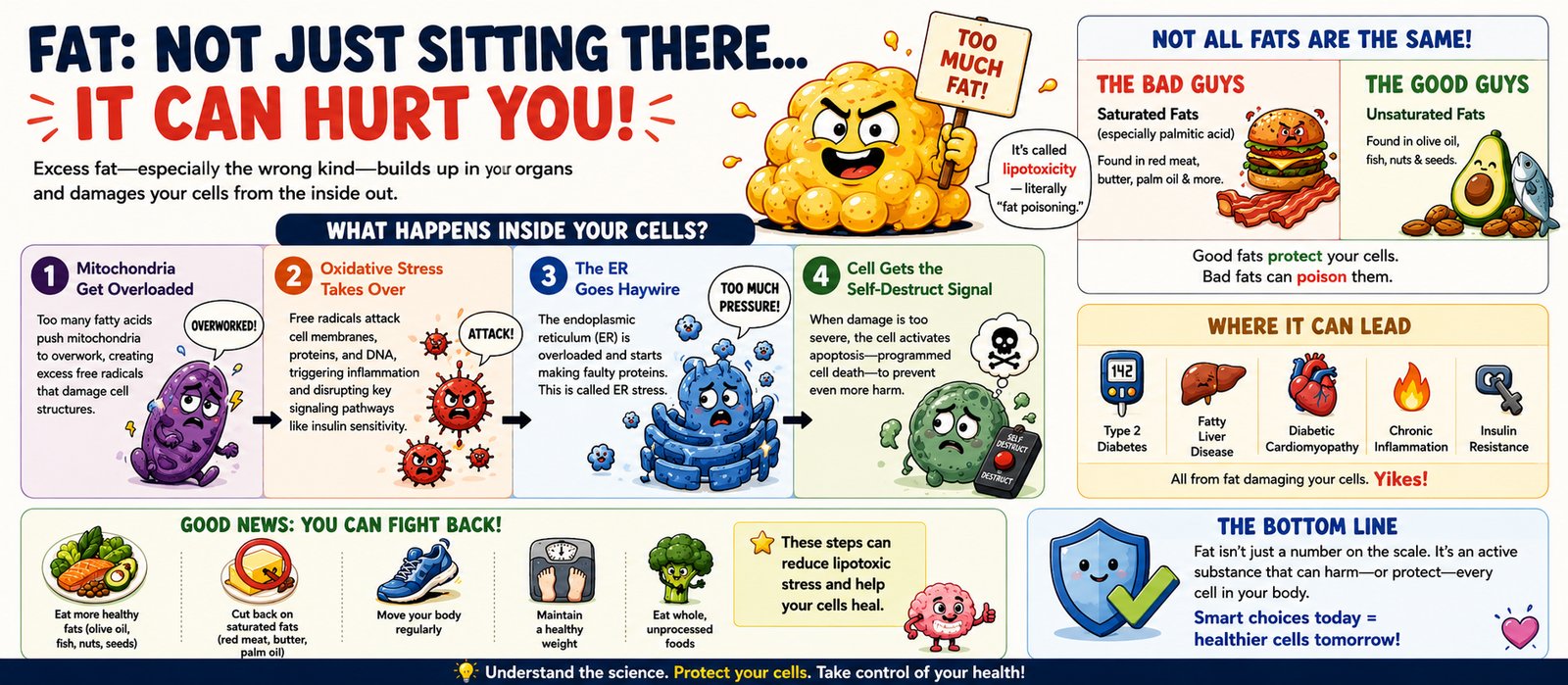
What Is Lipotoxicity
When fat cells get maxed out — the overflow starts accumulating where it was never supposed to be. In your muscles. Your liver. Your pancreas. Your heart.
This is called lipotoxicity. Literally — fat poisoning.
These organs weren't designed to store fat. When it builds up inside them — they start breaking down.
What Actually Happens Inside Your Cells
Your mitochondria get overloaded.
Mitochondria are your cells' power plants. When there are too many fatty acids — mitochondria start working overtime. The fat-burning process gets overwhelmed and produces excess free radicals — molecules that literally oxidize and damage cellular structures.
Think of it like an engine running on the wrong fuel at too high a temperature. Eventually something breaks.
Oxidative stress takes over.
Free radicals attack cell membranes, proteins, and DNA. This triggers inflammatory processes and disrupts the signaling pathways that regulate insulin sensitivity — which is exactly how type 2 diabetes develops.
The endoplasmic reticulum breaks down.
This is a structure inside the cell responsible for producing proteins. Fat overload overwhelms it — and the cell starts producing defective proteins. This is called ER stress — and it activates the cell's self-destruction program.
The cell gets the signal to destroy itself.
When the damage gets severe enough — the cell triggers apoptosis. Programmed cell death. It's actually a protective mechanism — but when too many cells die, organs start losing function. Permanently.
Which Fat Is The Most Dangerous
Not all fat is equally destructive at the cellular level.
Saturated fatty acids — especially palmitic acid found in red meat, butter, and palm oil — cause the most damage to cells.
Unsaturated fatty acids — olive oil, fatty fish, nuts — actually reduce lipotoxic effects and protect cells from damage.
Same calorie count. Completely different impact on your cells.
What This Leads To
Lipotoxicity is one of the key mechanisms behind:
Type 2 diabetes — fat destroys the pancreatic cells that produce insulin
Non-alcoholic fatty liver disease — one of the fastest growing conditions in America
Diabetic cardiomyopathy — damage to the heart muscle
Chronic inflammation — linked to almost every major disease
Insulin resistance — which quietly develops years before diagnosis
What This Means For You
We're not talking about visible fat here. We're talking about processes happening inside your cells right now — long before any symptoms show up.
The good news? These processes are reversible in the early stages.
Reducing saturated fat in your diet. Replacing it with unsaturated fat. Regular movement. Maintaining a healthy weight. These aren't just aesthetic goals — they're literally protecting your cells from the inside.
Bottom Line
Fat isn't just a number on the scale. It's an active biological substance that — in excess — starts affecting the function of every cell in your body.
Understanding what happens at the molecular level changes how you think about food. Not as a diet. Not as restriction.
As cellular protection. 💙